Oxford vs Derby Shoes: Which Should Men Choose?
Most men who own dress shoes couldn’t tell you what type they are. They know they’re leather. They know they have laces.
Beyond that, it’s a blur. Which is fine — until it isn’t. Until you show up to a job interview in the wrong shoe for a formal suit, or you buy a pair for a wedding and realise a week out that they don’t close properly over your foot, or you try to pull off a smart-casual look and the shoe is fighting everything above it.
The Oxford vs Derby distinction is one of the most practically useful things to understand about men’s dress shoes — not because the terminology matters, but because the difference between them has real consequences for fit, formality, and what you can actually wear them with. Get this right and dress shoe decisions stop being guesswork.
This guide covers what separates an Oxford from a Derby at the construction level, why it matters, which one works for which occasions and outfits, and which specific styles within each category are worth owning.

By the end, the answer to “which should I choose” will be obvious — because it’s different for every man, and you’ll know which one you are.
The One Construction Detail That Explains Everything
Before the comparisons, the single fact that makes the whole thing make sense.
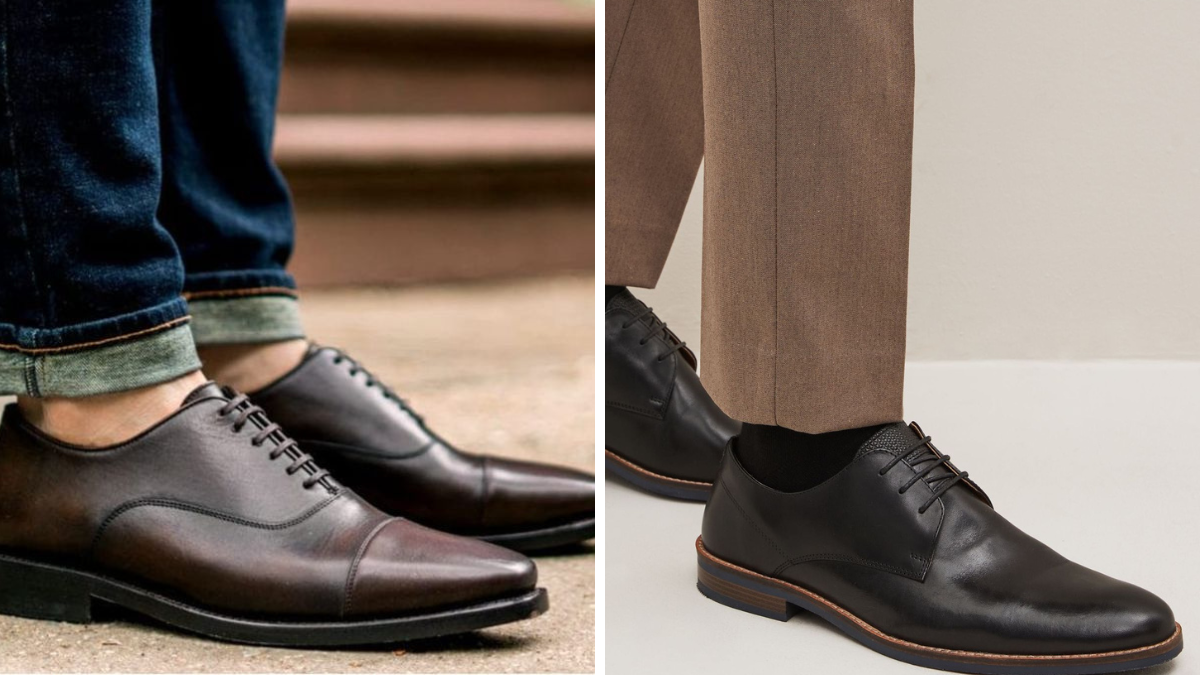
An Oxford has a closed lacing system. The two pieces of leather that hold the eyelets (called the “quarters”) are stitched underneath the vamp (the main body of the shoe).
This means when you tighten the laces, the sides of the shoe are pulled toward each other with nowhere to open further. The result: a sleeker, more tapered profile and a shoe that sits lower on the foot.

A Derby has an open lacing system. The quarters are stitched on top of the vamp, which means they can spread open freely when unlaced. The shoe sits more open across the instep, accommodates a wider range of foot shapes, and generally has a slightly more casual, relaxed silhouette.
That’s it. That’s the entire structural difference. Everything that follows — the formality hierarchy, the fit implications, the styling rules — flows directly from those two construction approaches.
Oxford vs Derby: The Key Differences That Matter in Real Life
1. Formality Level — Why the Oxford Wins Black Tie and the Derby Wins Everyday
The Oxford is the more formal shoe. Full stop. The closed lacing system creates a tighter, more streamlined silhouette that reads as more disciplined and refined — which is why it’s the correct choice for black tie, morning dress, and the most formal business occasions. When the dress code specifies “formal,” an Oxford is the answer.
The Derby sits one tier below. It’s still a dress shoe — absolutely appropriate for business professional, smart-casual, and most weddings as a guest. But the open lacing creates a more relaxed visual profile that reads as slightly less ceremonial. This isn’t a criticism. For most men’s actual lives — offices, events, dinners, occasions that require leather shoes but not white tie — the Derby’s formality level is the correct one.
Style tip: If you only own one pair of dress shoes, a Derby in dark brown or black is more practically useful than an Oxford of the same colour, purely because it spans a wider formality range without looking out of place.
2. Fit and Foot Shape — Why This Is More Important Than Formality
Here’s the thing most people skip over: Oxfords don’t fit all feet equally. The closed lacing means the shoe can only close so much.
Men with higher insteps, wider feet, or significant foot volume often find that an Oxford either won’t close properly (the two sides of the lacing can’t meet) or closes but puts uncomfortable pressure across the top of the foot.
Neither is acceptable.
A Derby, by contrast, accommodates foot variation naturally. The open lacing can spread as needed, which makes it a more forgiving fit for the majority of foot shapes.
In my experience working with clients, roughly two in three men are more comfortable in a Derby than an Oxford when both are in their correct size — not because the Oxford is poorly made, but because the closed system has inherent limits.
The practical check: If you try on an Oxford and the two sides of the tongue’s lacing section touch or nearly touch, the fit is correct. If there’s more than a centimetre of gap, either the shoe is too wide or your instep is too high for the last — try a Derby instead.
Style tip: If you have a wide or high-volume foot and love the Oxford’s aesthetic, look for brands that offer wider lasts. Loake’s “F” width and Allen Edmonds’ wide fit Oxfords are worth investigating before giving up on the style.
3. Which Suits Work With Each — The Specific Combinations That Matter
Suit matching with dress shoes is more specific than most men realise. Here’s the actual breakdown:
Black Oxford: Black tie (the only correct choice), charcoal grey suits for formal business, navy suits for formal occasions. The black Oxford is the most formal shoe in civilian dressing — use it accordingly.
Dark brown Oxford: Navy suits (an excellent pairing — navy and dark brown are complementary, not competing), charcoal suits for less formal settings. Avoid black suits with brown shoes — the contrast is too stark and reads as a mistake rather than a choice.
Black Derby: Business professional suits across the colour range. Charcoal, mid-grey, navy. Also works with formal occasion dressing where an Oxford feels excessive.
Tan or cognac Derby: Mid-grey suits, lighter navy, and notably — the most overlooked pairing — earth-toned or olive-adjacent suits. A tan Derby with a stone or beige suit is a sharp warm-weather combination.
Style tip: The rule “no brown in town” — meaning no brown shoes in formal city business settings — has lost most of its force in modern dress codes but still holds in the most conservative environments (banking, law, established firms). If in doubt about your specific workplace, black is never wrong.
4. The Plain-Toe vs Cap-Toe vs Brogue Question — Why It Matters More Than You Think
Within Oxford and Derby styles, toe treatment is the next variable — and it affects formality more than most men realise.
Plain-toe: The most formal. No ornamentation, no seams across the toe. A plain-toe Oxford in black is the most formally correct dress shoe in civilian life.
Cap-toe: A horizontal seam across the toe box creates a visual division between the toe and the vamp. Slightly less formal than plain-toe but still very formal — cap-toe Oxfords are the backbone of business professional and formal occasion dressing.
Brogue (full or semi): Decorative perforations (called broguing) along the seams and edges. The more broguing, the less formal.
A full brogue (also called a “wingtip”) has a W-shaped cap that extends to both sides of the shoe, heavily perforated.
This is the most casual of the three and works in smart-casual territory but looks out of place with very formal suits.
Style tip: Buying your first Oxford or Derby? Go plain-toe or cap-toe. The brogue can come later — it requires more outfit awareness to wear well, and the plain/cap-toe option will serve you correctly across more occasions.
💡 Pro Tip
The most common dress shoe mistake isn’t the wrong style — it’s the wrong condition. A mid-priced Derby that’s been regularly polished, conditioned, and stored on shoe trees will look significantly better than an expensive Oxford that’s been neglected. Before you spend money on another pair of shoes, spend fifteen minutes and $30 on a proper care kit: horsehair brush, Saphir Renovateur conditioner, and colour-matched polish. The shoe you already own will thank you.
Read also: 10 Sneaker & Outfit Combos That Always Win
5. Smart-Casual Styling — Where Derby Wins and Oxford Struggles
Smart-casual is the dress code most men navigate most often, and it’s where the Oxford-Derby distinction has the most practical impact.
The Oxford’s formality works against it in smart-casual contexts — a highly polished, sleek Oxford with jeans or chinos creates a formality mismatch that reads as “wearing dress shoes because I had to” rather than “this outfit is considered.” The shoe is trying harder than the rest of the outfit, and it shows.
The Derby, particularly in suede or in a slightly less formal leather, bridges the gap naturally. A suede Derby in chocolate brown or dark navy sits comfortably alongside dark jeans, tailored chinos, and smart-casual trousers without suggesting a different dress code was intended.
Style tip: For smart-casual, a suede Derby is more versatile than any leather Oxford. The texture reads as relaxed without losing the sophistication of a leather sole and proper construction.
Brands to look at: Tricker’s for traditional British suede Derbies (~$450–$600 USD), Thursday Boot Company for excellent mid-range suede options (~$199 USD).
6. Specific Oxford Styles Worth Knowing — Beyond the Generic Black Shoe
Not all Oxfords are the same, and knowing the subtypes saves you from buying the wrong one.
The Balmoral Oxford: The classic form — closed lacing, usually plain-toe or cap-toe, one-piece construction. The Allen Edmonds Park Avenue (~$395 USD) is the American benchmark in this category. Loake’s Aldwych (~$250 USD) is the British equivalent at a slightly lower price point.
The Wholecut Oxford: Made from a single piece of leather (or as few as two), with minimal seaming. Extremely sleek, extremely formal, extremely unforgiving of poor foot shape. This is the Oxford for men who know exactly what they’re doing and want a very clean aesthetic. Not a first purchase.
The Monkstrap Oxford: Technically uses a buckle-and-strap closure rather than laces, which puts it in a category of its own — formal enough for most suits, interesting enough to carry smart-casual. The double monk in particular (two straps) has become a staple of modern menswear precisely because it straddles formality tiers.
Style tip: For most men buying their first or second serious dress shoe, the Balmoral Oxford in dark brown is the entry point worth choosing. It’s versatile, it photographs well, and it signals awareness of classic menswear without being costume-y.
7. Specific Derby Styles Worth Knowing — The Underrated Variations
The Gibson Derby: The standard Derby form — open lacing, clean lines. This is the default when someone says “Derby.” In black or dark brown leather, it functions almost anywhere an Oxford would, with better fit accommodation.
The Brogue Derby (Semi or Full): The most casual end of the Derby spectrum. The Loake Ludlow full brogue (~$220 USD) is a classic example — heavy broguing, chunky enough for smart-casual, genuinely versatile over a wide trouser range.
The Chukka Boot: Technically not a Derby, but it shares the open lacing system and overlaps significantly in styling territory. Two eyelets, ankle height, usually in suede — the Clarks Desert Boot (~$140 USD) is the most widely worn version. For men who want the Derby’s versatility in a boot silhouette, this is the direction.
Style tip: A Derby with a dainite or commando rubber sole is a year-round shoe in a way that a leather-soled version isn’t. The rubber sole handles wet conditions, adds grip, and doesn’t require the care attention that a leather sole does. In climates with significant rain (common across East Africa’s long rains season), a rubber-soled Derby is the more practical and longer-lasting investment.
8. How to Choose Between Oxford and Derby: The Three-Question Test
If the above hasn’t resolved the question for you, three questions will:
Question 1: What’s the primary occasion you’re buying these for?
- Black tie or the most formal business settings → Oxford, full stop.
- Everything else → Derby is probably the better investment.
Question 2: What’s your foot shape like?
- Wide, high-instep, or high-volume foot → Derby. Don’t fight the closed lacing — it won’t win.
- Standard to slim foot → either works; try both and see which closes cleanly.
Question 3: Do you already own one?
- If you own an Oxford: buy a Derby next, particularly in suede for smart-casual.
- If you own a Derby: an Oxford in a different colour or toe treatment is worth adding if your lifestyle includes genuinely formal occasions.
Most men, answering honestly, will land on Derby as their first serious dress shoe. That’s not a compromise — it’s the correct call for a versatile wardrobe built around real life rather than theoretical formality.
Recommended Buys: Where to Start at Each Price Point
A few specific, trustworthy options if you’re ready to buy:
Entry-level ($100–$180 USD):
- Clarks Tilden Cap Oxford — reliable construction, widely available, decent leather for the price.
- Ecco Melbourne Derby — broader fit, comfort-focused, good for men on their feet all day.
Mid-range ($180–$350 USD):
- Thursday Boot Company Diplomat Oxford (~$199 USD) — Goodyear welted, resoleable, punches above its price.
- Loake Aldwych Derby (~$220 USD) — British made, genuine craftsmanship, a shoe you’ll own for ten years.
Investment ($350 USD+):
- Allen Edmonds Park Avenue Oxford (~$395 USD) — the American benchmark for formal footwear.
- Tricker’s Bourton Derby (~$500–$600 USD) — country brogue Derby that’s been in production in Northampton since 1829. The patina these develop is extraordinary.
The Bottom Line
Oxford vs Derby isn’t really a competition — they’re tools for different jobs. The Oxford is the more formal shoe, appropriate for the highest-dress occasions, built for slimmer and more standard feet. The Derby is more forgiving, more versatile, and for most men’s lives the more sensible starting point. Own one of each, in complementary colours, and you cover virtually every occasion that requires leather shoes.
Which one are you currently wearing — and which do you wish you’d bought instead? Drop it in the comments. And if this settled a debate you’ve been having with yourself for longer than you’d like to admit, save this for the next time someone asks why your shoes look so considered.
Read also: