How to Match Shoes With Any Outfit (Men’s Guide)
Most men dress from the top down. They pick a shirt, figure out the trousers, and then — standing in front of their wardrobe with three minutes until they need to leave — try to find shoes that don’t ruin everything.
This is the wrong order, and it explains why so many otherwise solid outfits fall apart at the foot. Shoes aren’t a finishing detail.

They set the register of an entire look.
Get them right, and the rest reads as intentional.
Get them wrong and even expensive clothes look like they don’t quite belong together.
Knowing how to match shoes with any outfit isn’t about memorising rules — it’s about understanding a few principles that do most of the work automatically.
Formality level.
Colour logic.

Proportion.
Once those click, you stop guessing and start just knowing.
This guide covers all of it: specific shoe-to-outfit combinations that actually work, the mistakes that silently undercut good dressing, and the underlying logic that makes the whole system portable to any situation you’ll find yourself in.
By the end of this, you’ll have a framework that works for a job interview, a weekend brunch, a first date, and everything in between.
The Three Principles That Drive Every Good Shoe-Outfit Match
Before the specific combinations, three ideas make the rest of this make sense. These aren’t rules handed down from a fashion authority — they’re observations from years of watching what works on real men in real situations.
Principle 1: Match formality, not just colour. This is the big one. A perfectly colour-matched shoe that’s at the wrong formality level will always look off. A brown Oxford with raw denim. White leather sneakers with a tuxedo. Flip-flops with tailored trousers. The mismatch isn’t about colour — it’s about register. Every shoe sits somewhere on a formality spectrum, and the outfit needs to sit in roughly the same place.
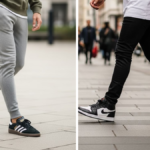
Principle 2: The shoe and trouser leg should speak to each other. Slim trousers with chunky sneakers create a top-heavy silhouette. Wide trousers with slim-soled dress shoes make the foot look like it disappears. Proportional harmony between the trouser hem and the shoe silhouette is what makes an outfit look considered rather than assembled.
Principle 3: When in doubt, go quieter at the foot. A loud shoe demands outfit confidence you may not have yet. Neutral shoes — white sneakers, tan loafers, black Oxfords – give you room to manoeuvre. The more you understand shoe matching, the more you can play with bolder footwear. Start quietly and make the noise.
How to Match Shoes With Every Major Outfit Type
1. How to Match Shoes With a Suit — The Formula That Never Fails
The suit is the easiest outfit to shoe correctly, because the formality bandwidth is narrow.
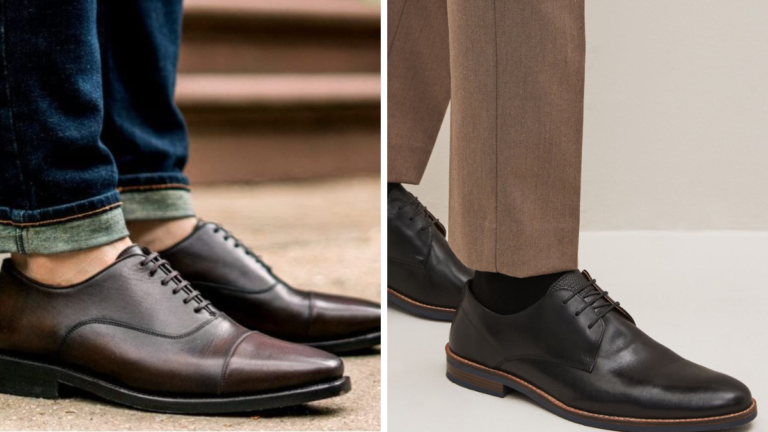
You’re looking at one of three options: Oxford (the most formal), Derby (slightly more relaxed), or loafer (smart-casual territory).
The colour matching follows a simple rule: match the shoe leather to the belt leather, and match both to the overall warmth or coolness of the suit.
Navy suit? Black Oxfords for a sharp, cold contrast.
Charcoal grey? Both black and dark brown work — dark brown actually flatters charcoal more than most men realise.
Mid-grey? Burgundy/oxblood is the move — it adds warmth without clashing. Tan or light brown suit? Light tan or cognac leather only — black reads funereal against warm-toned suiting.
Style tip: The shoe shouldn’t compete with the suit — it should complete it. If you’re wearing a suit for a job interview, black cap-toe Oxford in good leather is the answer every time. It communicates that you understand formality without trying to express personality through your shoes at the wrong moment.
Classic picks: Loake 1880 Aldwych Derby (~$250 USD), Allen Edmonds Park Avenue Oxford (~$395 USD).
2. How to Match Shoes With Dark Jeans — The Easiest Win in Men’s Dressing
Dark jeans (indigo, dark navy, charcoal wash) are the most shoe-flexible trouser in a man’s wardrobe.
They sit in a middle register — not as formal as tailoring, not as casual as shorts — which means they accept a wide range of shoes without conflict.
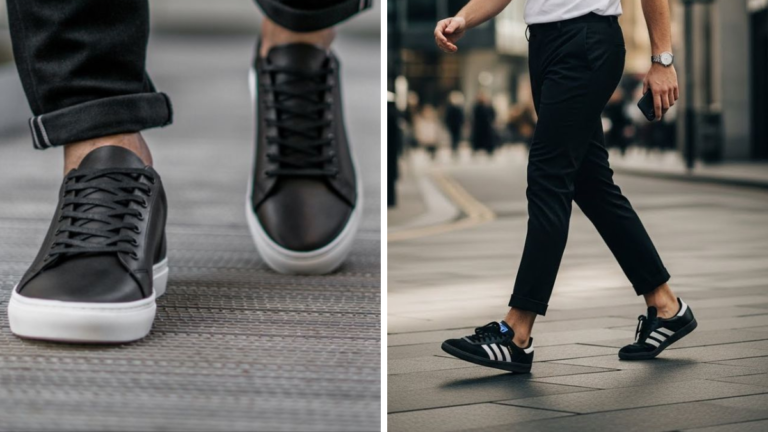
White leather sneakers. Chelsea boots. Derby shoes in brown or tan. Clean loafers. Even a well-chosen trainer works.
The shoe to avoid with dark jeans: anything too formal. Patent leather or very high-shine Oxford shoes create the same awkward register mismatch as sandals with a blazer — technically both are shoes, technically, both are trousers, but the combination doesn’t read right.
Style tip: Slim dark jeans with a white leather Oxford-style sneaker (Common Projects Achilles, Veja Campo) is one of the most reliable smart-casual combinations in existence. Add a tuck of a plain tee, a light jacket, and you’re done. This is the formula I come back to more than almost anything else.
3. How to Match Shoes With Chinos — Different Colours, Different Rules
Chinos present a colour-matching challenge that trips more men up than suits do, because the range is wider. Here’s the breakdown by chino colour:
Olive/khaki chinos: The most versatile. Work with white sneakers, tan loafers, brown suede Derby shoes, and even clean boots. Avoid black shoes — the contrast is high and the combination looks unintentional.
Navy chinos: Treat like a casual suit trouser. Brown leather shoes, white sneakers, and burgundy loafers all work well. Black shoes are possible but make the outfit feel heavier than it needs to.
Grey chinos: The most neutral base. Black, white, brown, and even bolder colourways (red sneakers, tan suede) all read correctly because grey doesn’t compete with much.
Camel/tan chinos: Tricky, because they share warmth with most leather shoe colours. White sneakers are the safest partner. Dark brown or oxblood leather works if the shoes are darker than the trouser — if they’re a similar shade, the outfit reads as unintentionally monochrome.
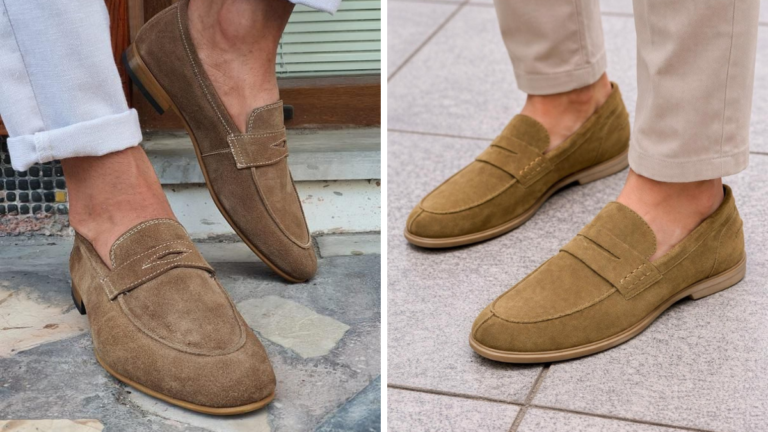
Style tip: Slim chinos with a suede loafer and no-show socks is one of the most underrated smart-casual combinations. The suede keeps it relaxed. The loafer keeps it sharp. And the exposed ankle keeps the whole thing looking like a choice rather than an accident.
💡 Pro Tip
Match your sock visibility to your outfit’s formality level. Suit and dress shoes: full-length socks, always. Smart-casual (chinos, loafers, blazer): no-show socks or sockless. Casual (jeans, trainers, tees): ankle socks or no-show, whatever you prefer. The problem most men have isn’t their shoes — it’s white athletic socks peeking out from under dark trousers and dress shoes. That one detail signals inattention more loudly than almost anything else in your outfit.
4. How to Match Shoes With Shorts — The Rule That Ends the Confusion
Shorts are where shoe matching gets genuinely confusing for most men, because the general advice (“keep it casual”) isn’t specific enough to be useful. Here’s the actual framework:
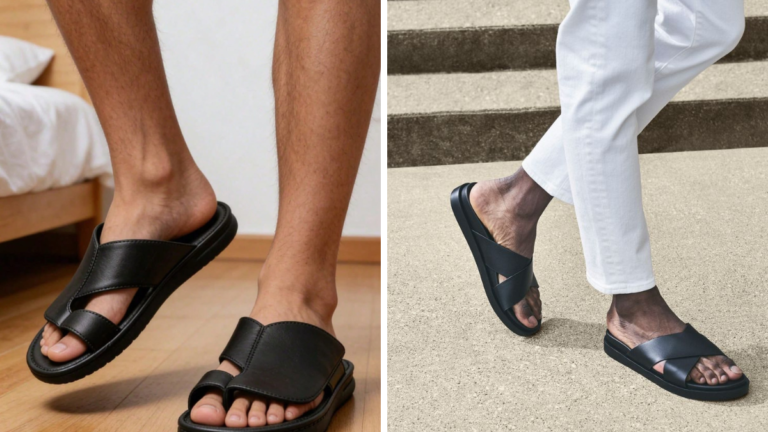
Shorts above the knee (swim trunks, board shorts, athletic shorts): Flip-flops, slides, or sports sandals only. This is the one category where a sandal is the appropriate shoe — trying to wear trainers or casual shoes here creates odd visual weight at the bottom of a very light outfit.
Mid-length casual shorts (chino shorts, linen shorts): Trainers, minimalist sneakers, leather sandals, loafers, or clean slip-ons. This is the sweet spot for most warm-weather casual dressing. Low-profile footwear keeps the visual weight balanced.
Tailored shorts or Bermuda-length shorts: Loafers or leather sandals. A trim Bermuda short with a linen shirt and a leather loafer is a complete, considered warm-weather outfit. Trainers can work but tend to pull the register down.
Style tip: Avoid high-top sneakers with shorts almost universally. The shoe-to-exposed-leg ratio creates a top-heavy silhouette that very few men can carry off. If you want to wear high-tops, wear them with trousers.
5. How to Match Shoes With Smart-Casual Outfits — The Register Most Men Get Wrong
Smart-casual is the most commonly requested dress code and the most commonly misunderstood.
Here’s what it actually means from a footwear perspective: shoes that have enough finish to feel considered, but not so much formality that they demand the rest of the outfit follow suit.
The sweet spot is: leather sneakers, suede loafers, clean leather Derbies, Chelsea boots, or minimalist leather sandals (in warm weather).
The out-of-bounds zones: athletic trainers (too casual), patent leather Oxfords (too formal), flip-flops (too casual), very worn or dirty shoes (inattentive).
I’ve dressed a lot of men for smart-casual events who came to me convinced they didn’t own the right shoes.
Almost always, they had something that worked — it just needed a clean, and perhaps some conditioning. A well-maintained shoe reads a full tier above a neglected one.
Style tip: If the invite says “smart-casual” and you own a pair of leather Chelsea boots, wear them. Dark leather Chelseas work with dark jeans, chinos, and even tailored trousers — they’re the single most format-flexible shoe in the smart-casual register.
Reliable picks: R.M. Williams Craftsman (~$595 AUD), Thursday Boot Company Duke Chelsea (~$199 USD).
6. How to Match Shoes With a Blazer and Jeans — The Combination That Lives or Dies by the Shoe
The blazer-and-jeans combination is extremely common and extremely easy to do badly. The shoe is usually what makes or breaks it. Here’s why: the blazer adds formality, the jeans subtract it, and the shoe has to either bridge the gap or commit to one side.
For dark jeans and a structured blazer: leather shoes (loafer, Derby, Chelsea boot) or premium leather trainers. This combination is trying to be smart-casual — help it get there with a shoe that leans in that direction.
For lighter jeans and an unstructured blazer: clean trainers work here. The outfit is casual with a layer of polish, and a nice white or neutral trainer reads as intentional rather than underdressed.
Style tip: The single shoe that does the most work in the blazer-and-jeans combination is a clean, unbranded leather loafer in tan or dark brown. It reads as thoughtful without demanding attention, and it flatters both the jeans and the blazer without forcing either to compromise.
7. How to Match Shoes With Formal Occasion Outfits — Going Beyond Black Tie Basics
Most men know the black-tie answer (black patent leather or highly polished black Oxford).
What fewer men know is how to dress for events below black tie but still requiring genuine formality — a wedding as a guest, a graduation, a formal dinner.
For these occasions: a polished leather Oxford or Derby in black or dark brown is the correct call. The specific shoe matters less than the leather quality and the condition.
A mid-priced shoe in genuinely good condition looks better than an expensive shoe that hasn’t been polished in six months.
The rule I give every client who asks about wedding guest dressing: if you’re not sure, wear the most formal shoes you own that are in the best condition.
Formality is forgiven upward. Showing up underdressed is harder to recover from.
Style tip: Invest in a shoe-care kit before you invest in another pair of shoes. Horsehair brush, leather conditioner, a tin of matching polish. Fifteen minutes of attention before a formal occasion is the difference between a shoe that looks expensive and one that just is.
Conditioning recommendation: Saphir Médaille d’Or Renovateur — widely available, works on all smooth leathers.
8. How to Match White Sneakers With Everything — The Universal Pairing Tool
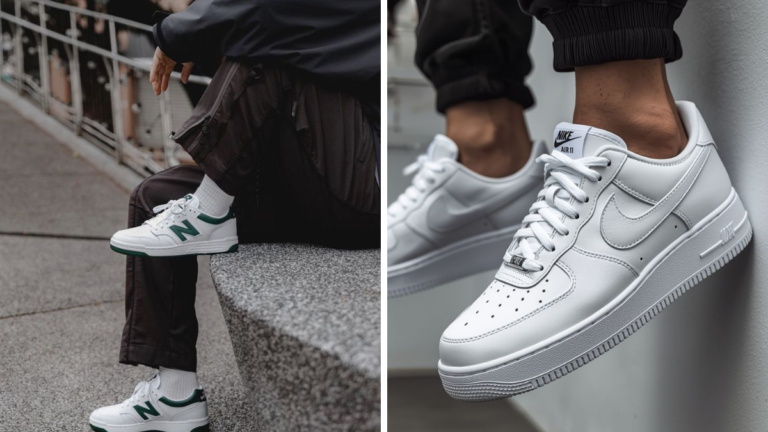
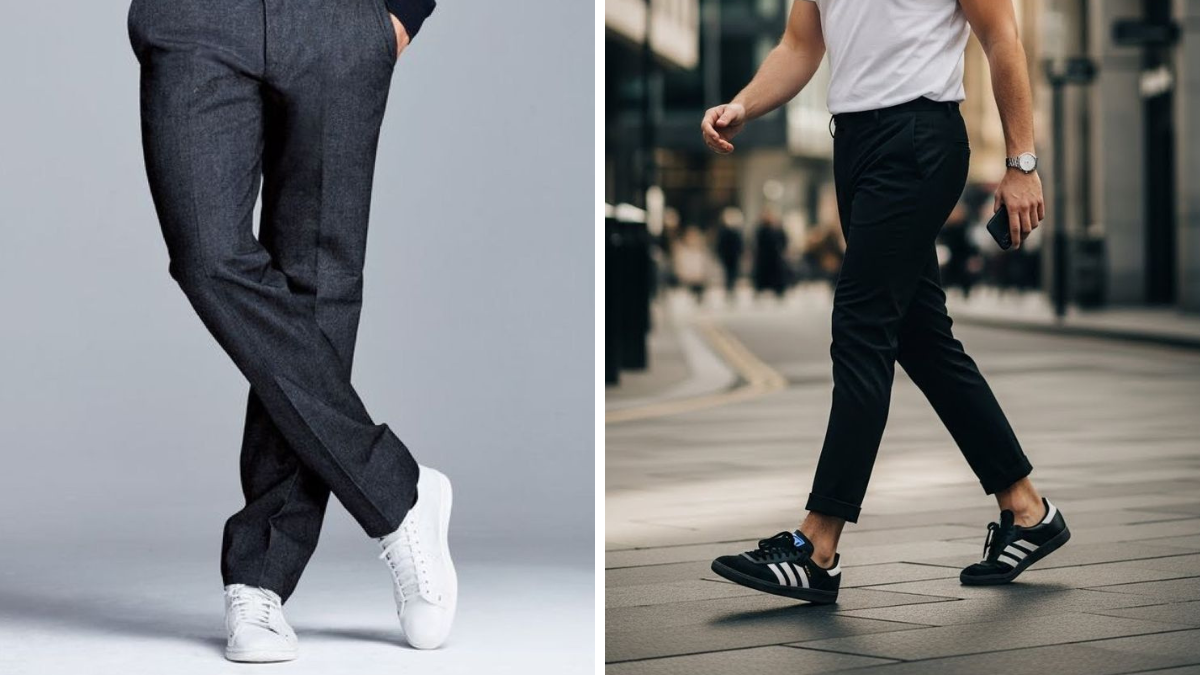
White leather sneakers are the most versatile shoe in most men’s wardrobes because they work across a formality range that no other shoe category covers: they can go with a suit (deliberately casual pairings), dark jeans, chinos, shorts, and smart-casual outfits with equal ease.
The key is that the sneaker must be clean — a yellowed, scuffed white sneaker reads as an outfit problem, not a stylish choice.
And yes, I know that sounds obvious, but the number of men I see trying to salvage a pair of beaten-up white sneakers with an otherwise carefully assembled outfit suggests it’s worth stating directly.
Style tip: White leather sneakers work best when the rest of the outfit has at least one structured element — a blazer, tailored trousers, a crisp shirt. Without that anchor, the outfit can slide into looking purely casual when you intended something more.
The benchmark pick: Common Projects Achilles Low (~$450–$500 USD). The reliable alternative: Veja Campo (~$150–$180 USD).
9. How to Match Shoes With an All-Black Outfit — Without Looking Like a Bouncer
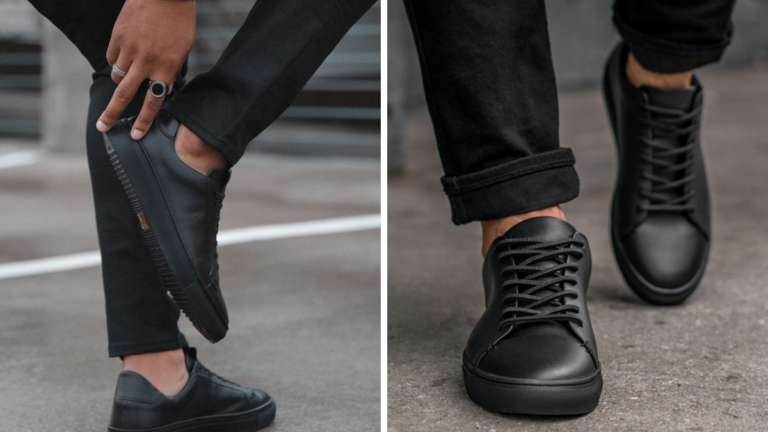
All-black dressing is popular for a reason — it’s easy, it’s slimming, and it photographs well. The shoe matching challenge is that all-black needs texture variation to avoid looking flat or uniform.
The worst version of all-black is monochromatic in both colour and material — same flat fabric, same matte black shoe, nothing to catch the eye.
The solutions: a black Chelsea boot in leather (the shine differentiates it). A black suede Derby (the nap differentiates it).
A white or off-white clean trainer (deliberate contrast that becomes a design element). Or, if you want the fully black-on-black look, texture is your only tool — a matte black suede against a black wool trouser, with a black leather boot finishing the stack.
Style tip: Skip the patent leather in all-black casual or smart-casual dressing — the formality is wrong for the context and the shininess reads as trying too hard. Black suede is the most wearable all-black shoe material for everyday situations.
10. How to Match Shoes With Colour — When the Rest of the Outfit Is Doing Something Bold
When you’re wearing a patterned shirt, a coloured trouser, or a printed jacket, the shoe’s job is to not compete. Neutrals only: white, black, tan, navy, or dark brown. This is not the moment for red sneakers or two-tone brogues.
The one exception: deliberate tonal dressing. If the outfit is a single dominant colour (all-olive, all-navy, head-to-toe camel), a shoe in the same family can work and even elevate the look.
But this requires intention and precision — slightly off and it looks like you couldn’t afford variety rather than choose coherence.
Style tip: When you can’t decide on a shoe colour, ask which colour appears most in the lower half of your outfit and match to that. Trouser-to-shoe harmony is the fastest route to a coherent look.
The Shoe Matching Mistakes That Quietly Undercut Everything
A few specific errors worth naming directly:
Wearing athletic socks with dress shoes. Covered in the Pro Tip above, but worth repeating: this single habit undermines more good outfits than any other shoe-related mistake.
Ignoring the trouser break. The amount of trouser fabric sitting on or breaking over the shoe affects the whole silhouette. Trousers that pool heavily over a dress shoe look sloppy. A clean break or slight crop almost always reads better in person and in photos.
Treating shoe maintenance as optional. A scuffed, unpolished leather shoe reads as inattention regardless of how much it cost. A well-maintained mid-priced shoe consistently reads better than an expensive neglected one.
Mixing different formality levels within the shoe itself. A brogue — a shoe with decorative perforations — is inherently more casual than a plain-cap Oxford, even in the same leather and colour. Wearing a highly decorative brogue with a formal suit creates internal inconsistency that trained eyes notice.
The Bottom Line
Matching shoes to outfits isn’t about memorising colour charts — it’s about understanding formality level, proportion, and when to go quiet versus when to let the shoe speak. Once those three things are instinctive, you’ll stop second-guessing and start just dressing.
Which of these combinations are you going to try first? Or is there a specific outfit pairing you’ve always struggled with? Leave it in the comments — I read every one. And if this shifted how you think about shoes, save it for the next time you’re standing in front of your wardrobe trying to make a decision.
Read also: