The Only 3 Belts a Man Needs (And How to Wear Each One)
Men’s belts are one of those wardrobe categories where the math should be simple — and somehow never is.
You either own one tired brown belt that gets pressed into service for every occasion, regardless of whether it belongs, or you have a drawer full of belts you never wear because none of them quite fit the moment.
Either way, the result is the same: an almost right outfit, undermined by the one detail that’s holding it back.
Here’s the thing about belts — they’re not background noise. A belt is one of the most visible accessories a man wears, sitting at the precise centre of any outfit and directly connecting the upper and lower halves.
Get it right and the whole look clicks together. Get it wrong — wrong colour, wrong width, wrong formality — and something about the outfit feels subtly off, even if no one can articulate exactly why.
The good news is that you don’t need a collection. You need exactly three belts, chosen with intention, and you need to understand how and when to wear each one. This guide covers all of it — what the three belts are, what to look for when buying each, and the specific styling rules that make them work.
Why Most Men Get Belts Wrong
Before getting into the three essential belts, it’s worth understanding the most common belt mistakes — because avoiding them is half the battle.
Wrong colour matching. The foundational rule of belt-wearing is that your belt should broadly match your shoes in tone. Black shoes, black belt. Brown shoes, brown belt. Tan shoes, tan belt. Breaking this rule isn’t always wrong — but it needs to be intentional, not accidental.
Wrong width for the occasion. Belt width is a formality signal. Narrower belts (25–30mm) read as dressy and pair with formal trousers and dress shoes. Wider belts (35–40mm) read as casual and pair with jeans and chinos. Wearing a wide casual belt with a suit looks wrong. Wearing a narrow dress belt with jeans looks equally wrong.
Cheap buckles. The buckle is the most visible element of a belt. A thin, flimsy, or plasticky buckle undermines even quality leather. A simple, solid metal buckle — in a brushed or polished silver, gunmetal, or antique brass — reads as intentional quality regardless of the leather’s price point.
Wearing a belt when you don’t need one. Trousers that fit at the waist don’t require a belt. If you’re cinching a belt to keep your trousers up, the trousers don’t fit. A belt worn purely for function on poorly fitting trousers draws attention to the problem rather than solving it.
Ignoring the tip. The belt tip (the end that goes through the buckle) should extend between 3 and 5 inches past the buckle — ideally pointing to the first or second belt loop past centre. Too short looks wrong. Too long looks sloppy. This is a detail most men never think about and yet notice instantly when it’s off.
With those errors in mind, here are the only three belts you need.
Quick Styling Rules for Men’s Belts
1. Match leather tone to shoe tone. Not exact-match — tone-match. Your belt and shoes don’t need to be identical, but they should live in the same colour family.
2. Match metal to metal. If your belt buckle is silver, your watch and other visible metal accessories should ideally also be silver. If your buckle is gold or brass, match to gold and brass. This is a subtler rule than the leather-shoe match, but it adds a level of coherence that separates considered dressing from accidental dressing.
3. Width signals formality. Narrow = formal. Wide = casual. Match the width to the occasion.
4. The belt should disappear into the outfit. The best belt is one you don’t consciously notice — it completes the look without calling attention to itself. Statement belts (logo-heavy, novelty buckles, unusual materials) only work when they are the deliberate centrepiece of an outfit, not an afterthought.
5. Tuck the tail properly. The tail of the belt passes through the first belt loop on the left of the buckle. When the tip exits the buckle, it should thread through that loop cleanly. A tail that flops freely is a common oversight that undermines an otherwise polished look.
6. Leather belts need care. A leather belt that’s cracking, peeling, or losing colour is worse than no belt at all. Condition leather belts periodically with a leather conditioner, store them rolled or hung (never folded), and replace them when they show significant wear.
The Only 3 Belts a Man Needs
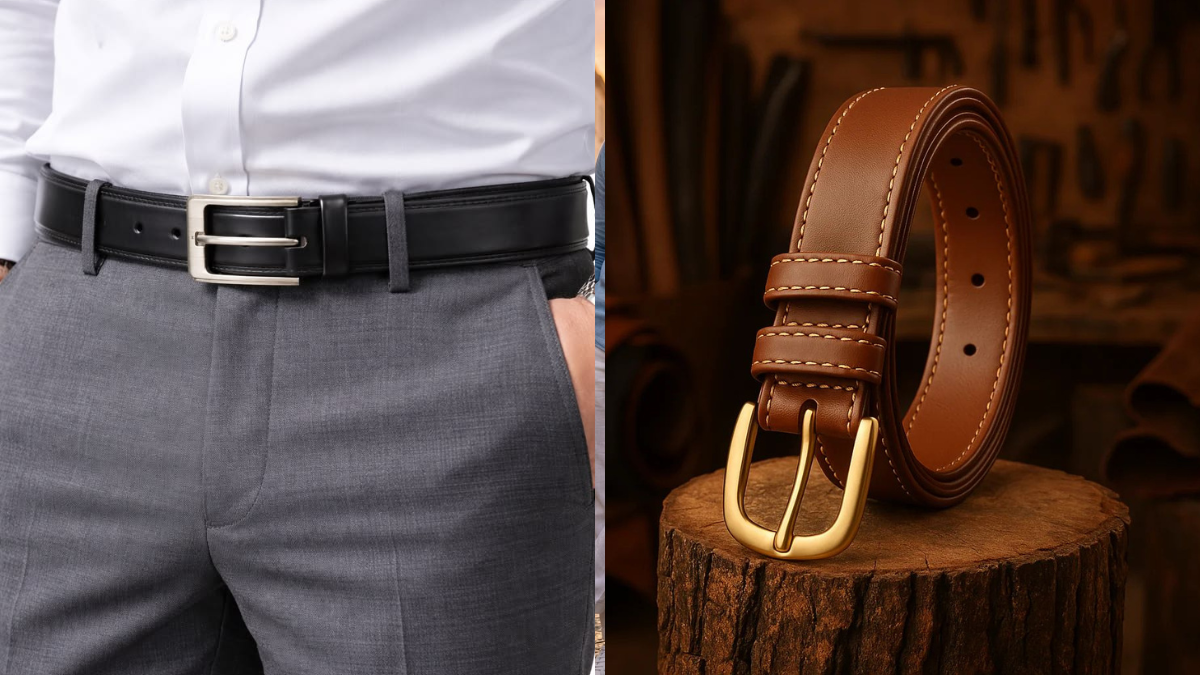
Belt 1: The Black Leather Dress Belt
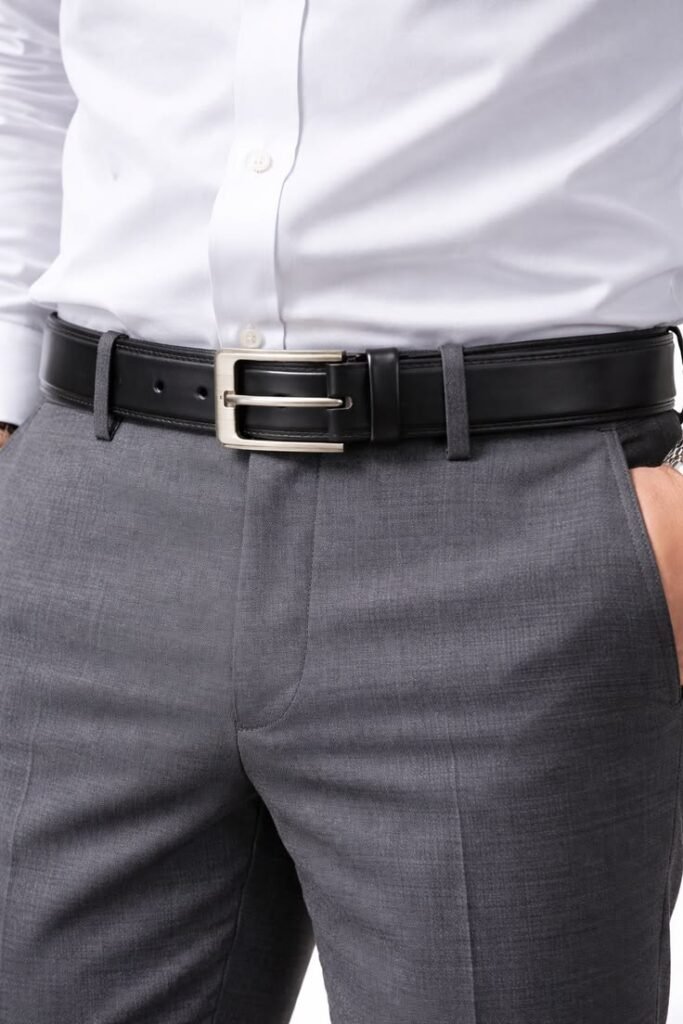
Width: 28–32mm
Buckle: Simple rectangular or rounded, polished or brushed silver/gunmetal
Finish: Smooth, flat leather — no texture, no embossing
Best for: Formal occasions, business professional, dress trousers, dark suits, smart-casual with black footwear
The black leather dress belt is the most formal belt a man should own, and it exists to serve one specific purpose: to complete a dressed-up outfit that includes black leather footwear. It pairs with black Oxford shoes, black derby shoes, and black Chelsea boots. It belongs with a suit, with dress trousers, and with the smarter end of smart-casual dressing. It does not belong with jeans, with white sneakers, or with casual outfits where a narrower, more refined belt looks incongruous with the relaxed register of the clothing.
The key characteristics of a good black dress belt are simplicity and restraint. Smooth leather — not pebbled, not embossed, not patent — in a true black tone. A clean, solid-metal buckle with a single prong. No logo hardware, no decorative stitching, no studding. The narrower the belt and the simpler the buckle, the more formally appropriate it reads.
What to look for: Full-grain or top-grain leather will hold its colour, resist creasing, and develop a patina over time. Bonded leather and split leather look presentable new but deteriorate within a year or two of regular wear. A stitched edge (a visible line of stitching along the leather’s perimeter) is a mark of quality construction. Width should sit between 28mm (for genuinely formal occasions) and 32mm (the upper limit for dress wear).
Where to wear it:
- With a navy or charcoal suit + white shirt + black Oxford shoes → formal business or event dressing
- With black tailored trousers + white dress shirt + black derby shoes → business professional
- With dark slim jeans + a blazer + black Chelsea boots → smart casual evening
- With charcoal chinos + a light blue shirt + black loafers → polished office
What NOT to pair it with:
- Brown, tan, or white shoes (colour mismatch)
- Jeans and a tee in a purely casual setting (too formal for the outfit’s register)
- Casual trainers or sports shoes
- Any outfit where the belt’s narrowness looks out of proportion with wide-leg or heavily casual trousers
Styling detail: Keep the buckle tone consistent with other visible metal on your person. If you wear a silver watch — which most men do — a silver or gunmetal buckle creates coherence. A gold buckle on a silver-watch wrist is a detail that fashion editors will notice, even if most people won’t.
Belt 2: The Tan or Brown Leather Casual Belt
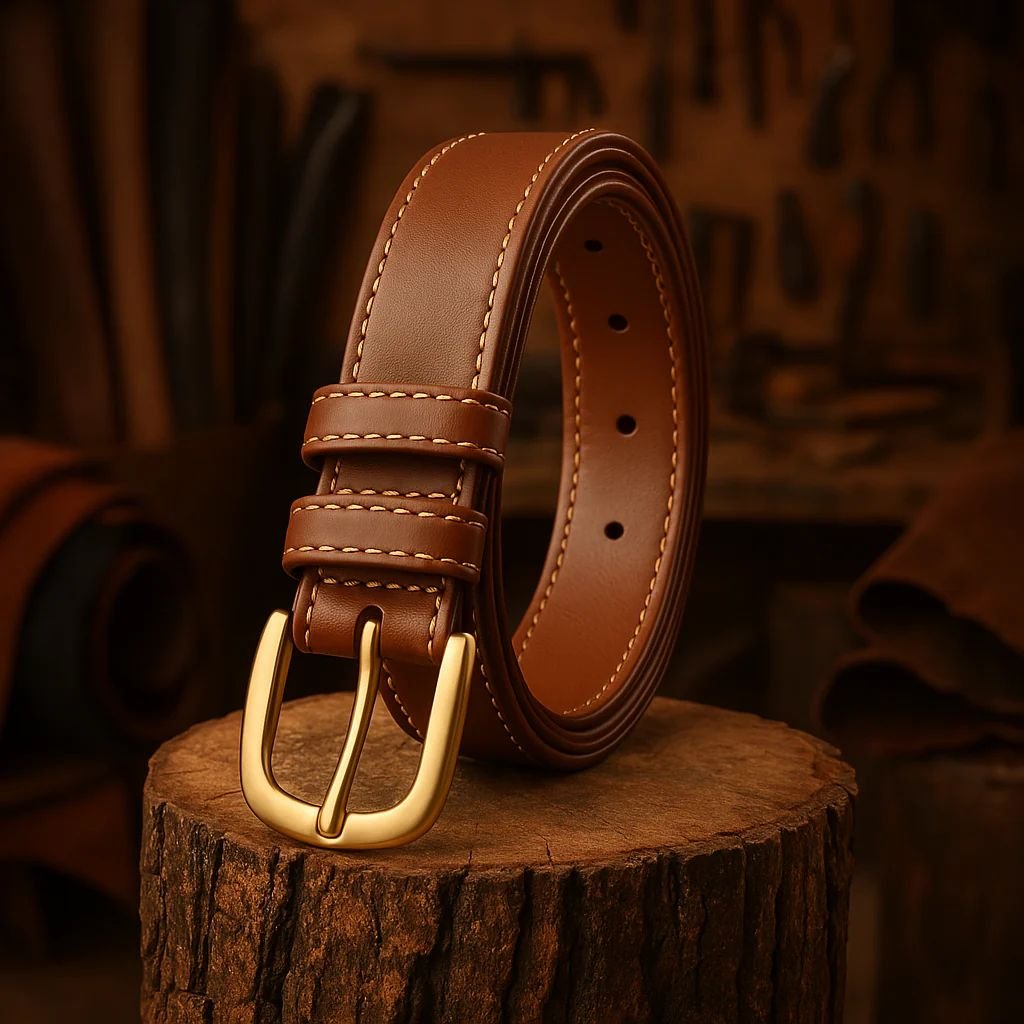
Width: 32–38mm
Buckle: Simple rectangular or rounded, antique brass, matte gold, or brushed silver
Finish: Smooth or slightly textured — pebbled grain and burnished leathers work well
Best for: Chinos, casual trousers, dark jeans, smart casual, everyday wear, brown or tan footwear
If the black dress belt is the formal specialist, the tan or brown leather casual belt is the everyday workhorse — the belt that earns its place through sheer frequency of use. It pairs with the widest range of outfits a man encounters day to day: navy chinos and loafers on a Tuesday, dark jeans and Chelsea boots on a Friday evening, beige chinos and white sneakers on a Saturday afternoon.
The brown-to-tan spectrum is vast, and the choice of shade matters. A mid-brown belt has the broadest range — it works with tan shoes, cognac brown shoes, and even white sneakers in a casual context. A darker mahogany or chocolate brown is more formal and sits closer to the black belt’s territory in terms of occasion. A tan or caramel belt is the most casual and pairs particularly well with lighter coloured trousers, white sneakers, and summer-weight footwear.
Ideally, own one belt in a medium brown and one in a tan or caramel — together, they cover virtually every casual and smart-casual situation. If owning only one, mid-brown is the most universally flexible choice.
What to look for: The same quality criteria as the dress belt apply — full-grain or top-grain leather, clean stitched edge, solid metal buckle — but the width can increase slightly (up to 38mm) and the finish can take on more texture. A pebbled, burnished, or slightly matte leather reads appropriately casual without looking cheap. Antique brass or matte gold buckles work particularly well with warm leather tones; silver or gunmetal suits cooler browns and tan.
Where to wear it:
- With navy chinos + a white Oxford + tan loafers → smart casual office
- With beige chinos + a striped tee + white leather sneakers → clean casual weekend
- With dark slim jeans + a cream knit + brown suede Chelsea boots → elevated autumn casual
- With olive chinos + a camp collar shirt + leather sandals → summer smart casual
- With straight-leg jeans + a denim jacket + boots → classic casual layered
What NOT to pair it with:
- Black dress shoes in a formal setting (tone mismatch)
- Formal suits (width is too casual for the trouser cut)
- Outfits where the belt’s casual width sits awkwardly against very dressy tailoring
Styling detail: A belt with a slightly worn, burnished quality — where the edges show a hint of use and the leather has developed character — often looks significantly better than a pristine new belt in casual contexts. Quality leather ages attractively; don’t be too precious about maintaining an artificially new appearance.
Belt 3: The Fabric or Woven Belt
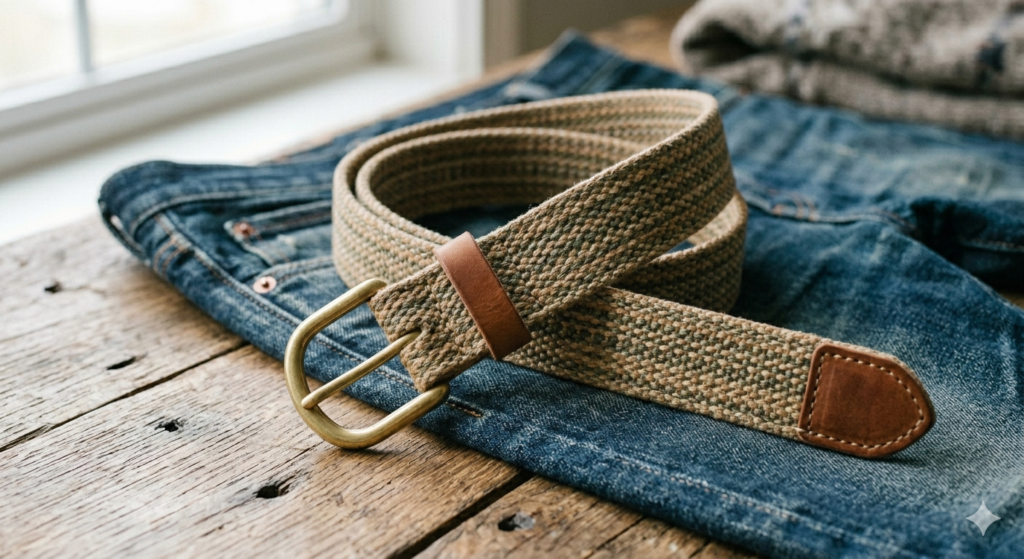
Width: 30–38mm
Buckle: D-ring, O-ring, sliding bar, or simple pin prong — usually in brass or silver
Finish: Woven cotton, braided leather, canvas, or webbing
Best for: Summer, casual warm-weather dressing, shorts, linen trousers, chinos, boat shoes, espadrilles, holiday outfits
The third belt is the one most men don’t own — and the one that quietly transforms summer and casual warm-weather dressing. A fabric or woven belt (canvas webbing, braided cotton, or woven leather) brings a relaxed, textural quality to summer outfits that a leather belt simply can’t replicate. Where leather looks slightly heavy and formal against linen trousers and canvas shoes, a fabric belt feels proportionate, breathable, and perfectly pitched to the casual register.
The most classic version is a canvas or webbing belt in a solid colour or a simple stripe pattern, with a D-ring or O-ring closure (rather than a standard pin-prong buckle). Navy-and-white or red-and-white striped canvas belts have strong maritime and preppy connotations that suit a very specific wardrobe aesthetic — clean, coastal, summer-smart. A solid navy, olive, or khaki canvas belt is more universally wearable.
The alternative is a braided leather belt — woven strips of leather in tan, cognac, or brown — which bridges the gap between the fabric belt’s casual ease and the leather belt’s more structured quality. A braided leather belt works well with chinos and loafers in a smart-casual summer context where you want something lighter than a full dress belt without fully abandoning the leather aesthetic.
What to look for: Quality canvas or cotton webbing that won’t fray, stretch, or lose its colour quickly. A metal ring closure that sits flat and doesn’t create unnecessary bulk at the front of the trousers. D-ring and O-ring closures are the most visually clean; avoid plastic hardware. For braided leather, look for genuine leather strips rather than synthetic braiding that cracks with wear.
Where to wear it:
- With beige linen shorts + a white tee + espadrilles → summer casual resort
- With navy chino shorts + a polo shirt + boat shoes → preppy summer smart-casual
- With light khaki trousers + a linen shirt + leather sandals → warm-weather smart casual
- With olive shorts + a camp collar shirt + canvas sneakers → casual summer festival or market
- With straight-leg jeans + a striped tee + canvas sneakers → relaxed weekend
What NOT to pair it with:
- Formal trousers or suits (completely wrong register)
- Heavy winter outfits (look out of place against thick fabrics and heavy shoes)
- Very dressy occasions (a fabric belt signals casual, which is appropriate in casual contexts only)
Styling detail: The D-ring canvas belt, in particular, allows for precise length adjustment — there’s no fixed hole system as with a prong belt, so you can achieve a perfectly flat, gap-free front that a standard belt sometimes can’t replicate. Thread the tail through the D-rings cleanly and trim any excess if the belt is significantly too long for your waist.
The 3 Belts at a Glance
| Belt | Width | Buckle | Best With | Avoid With |
|---|---|---|---|---|
| Black Leather Dress Belt | 28–32mm | Silver/gunmetal pin | Suits, dress trousers, black shoes | Casual jeans, brown shoes |
| Tan/Brown Leather Casual Belt | 32–38mm | Brass/silver pin | Chinos, jeans, casual trousers | Formal suits, black dress shoes |
| Fabric or Woven Belt | 30–38mm | D-ring, O-ring | Shorts, linen trousers, summer | Formal occasions, heavy winter outfits |
Mini Style Guide
How to Match Belts to Shoes
The single most important belt rule is matching your belt to your shoes in terms of leather colour and finish. Here’s a simple reference:
Black shoes → Black leather dress belt Black Oxford black derby, black Chelsea boot black loafer — always pair with a black belt in a smart or smart-casual context.
Brown or tan shoes → Brown or tan leather casual belt Cognac Chelsea boots, tan brogues, dark brown loafers, suede shoes — pair with a brown or tan belt that matches in warmth. Dark shoes pair with darker belts; lighter tan shoes pair with tan or caramel belts.
White sneakers → Tan leather casual belt or fabric belt White sneakers don’t require a strict colour match — a tan or caramel leather belt in a casual width works well, as does a fabric belt in a complementary colour. A black belt with white sneakers can look harsh in casual contexts.
Sandals or espadrilles → Fabric belt or no belt In very casual, warm-weather outfits with open footwear, a fabric or woven belt is the appropriate choice. A leather belt can feel heavy and out of proportion with the casual lightness of sandals and espadrilles.
Boots → Match the boot leather Brown suede boots → tan or mid-brown leather belt. Dark leather boots → dark brown or black leather belt, depending on the specific shade and occasion.
What to Spend on Each Belt
Black dress belt: Spend here. This belt appears at your most important occasions — job interviews, weddings, formal dinners, client meetings. A quality leather dress belt from a reputable brand (Anderson’s, Magnanni, Ralph Lauren) will last a decade or more and always look appropriate. Budget: $60–$150.
Tan/brown casual belt: Worth a solid mid-range investment. You’ll wear this belt more than any other. A quality mid-brown leather belt in a good fit and width is one of the best value-per-wear purchases in a wardrobe. Budget: $40–$100.
Fabric belt: Lower investment appropriate. Canvas and webbing belts are inherently more casual and less durable than leather — there’s no need to overspend. A well-made canvas belt at a sensible price point does the job perfectly. Budget: $20–$50.
Common Belt Mistakes — Revisited
- The oversized buckle. A large, logo-heavy buckle (Gucci, Hermès H, etc.) on a plain leather belt is a statement piece, not a wardrobe essential. Own it as a deliberate statement if you choose, but don’t confuse it with a functional belt for everyday wear.
- The wrong length. The tip of the belt should end between the first and second belt loop past the buckle — roughly 3–5 inches of tail. Check before you leave the house.
- Matching belt to trousers instead of shoes. A tan belt with beige chinos and black shoes looks mismatched. The shoe is the reference point, not the trouser.
- Wearing a belt with trousers that have no belt loops. Some dress trousers and many formal trousers are designed to be worn with braces or a fitted waistband — forcing a belt through a pair of loop-less trousers looks amateurish.
- Ignoring the belt when the outfit is otherwise complete. The belt is the last thing you think about and one of the first things people notice. Check it deliberately, not as an afterthought.
Frequently Asked Questions
Should a man’s belt always match his shoes? Broadly, yes — and it’s the most reliable rule to follow. Your belt and shoes should match in leather colour family: black belt with black shoes, brown or tan belt with brown shoes. An exact match isn’t required — the same colour family is sufficient. The one exception is very casual outfits with white sneakers, where a tan or fabric belt works regardless of the sneaker colour.
What width belt should men wear? Belt width should match the formality of the occasion. For formal wear and business dress, 28–32mm is appropriate. For smart-casual and everyday chinos or jeans, 32–38mm works well. For very casual wear — shorts, linen trousers — a fabric belt in a slightly wider width reads correctly. The narrower the belt, the more formal it reads; the wider, the more casual.
Can men wear a belt with jeans? Absolutely — in fact, a belt with jeans is one of the most common and natural combinations in men’s casual dressing. Choose a casual leather belt in mid-brown or tan at 32–38mm width, paired with the colour family of whatever shoes you’re wearing. Avoid narrow dress belts with jeans — the width mismatch looks off.
How do you know if a belt is good quality? Look for full-grain or top-grain leather (not bonded or split leather, which degrades quickly), a clean stitched edge, a solid metal buckle with a secure pin mechanism, and even, consistent colouring without patches or variation. A good belt will feel substantial and supple — not stiff and plasticky. The stitching should be tight and even, not looping or uneven.
Can men wear a belt and suspenders at the same time? No — never. Braces (suspenders) and a belt serve the same function and are mutually exclusive. Wearing both simultaneously suggests either your trousers don’t fit or you’re uncertain which one you trust — neither is a good look. Choose one: braces for a classic tailored look, belt for everything else.
Conclusion
The belt drawer that contains three carefully chosen belts — one black leather dress belt, one tan or brown leather casual belt, and one fabric or woven belt — outperforms a drawer of fifteen mediocre, random ones every single time. Not because minimalism is inherently virtuous, but because the right three belts cover every occasion a man’s wardrobe encounters, and cover them well.
Buy quality over quantity. Match to your shoes. Match your metals. Get the width right for the occasion. And then stop thinking about belts — because when they’re done right, you genuinely shouldn’t notice them at all.
Read also: